
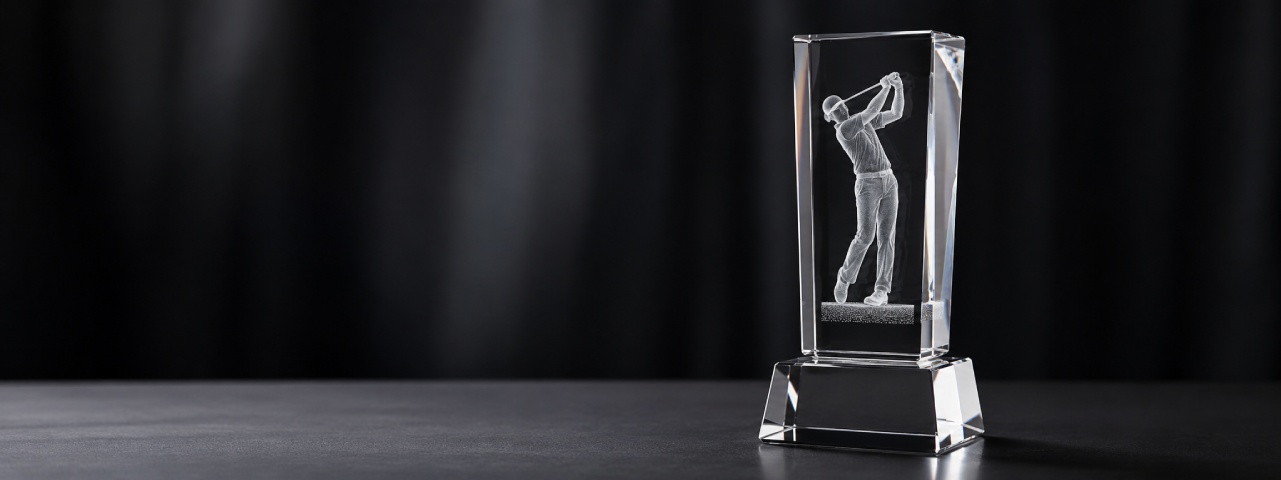
Optical crystal is what you reach for when a piece needs to feel like an heirloom the moment somebody picks it up. It has weight, it has clarity, and it refracts light in a way that ordinary glass simply cannot. If you have ever held a sales achievement trophy that genuinely impressed the recipient, odds are good you were holding optical crystal. This guide walks through what the material actually is, how it gets shaped and etched, what drives the price, and how to choose the right piece without overspending or underspending for the moment.
Viking Awards has been cutting, etching, and shipping crystal pieces from Westchester, Illinois since 1973. In that time we have seen every kind of corporate recognition program, every retirement gift, every hall-of-fame induction you can imagine. The notes below come from that bench-level experience, not from a marketing deck. By the end you should know exactly what to ask for, what to skip, and where the budget should actually go. If you want to skim live inventory while you read, our optical crystal awards category is a good place to anchor.
What Optical Crystal Actually Is
Optical crystal is a high-purity, lead-free glass formulation engineered for clarity. The most common type used in the awards industry is K9, sometimes called K9 optical glass. The K9 designation refers to a borosilicate crown glass with a refractive index near 1.516, which is what gives the material its prism-like behavior in sunlight or under spotlights. It contains no lead, which matters for both safety and shipping regulations, and it polishes to a glass-smooth finish on every face.
There is also true lead crystal, which historically meant a glass containing at least 24 percent lead oxide. Lead crystal has slightly more sparkle because of that elevated refractive index, but it is heavier, more fragile, more expensive to ship, and increasingly restricted in food and drink applications. For award use, lead crystal has largely been replaced by K9 optical crystal because the visual difference is small, the durability is better, and the cost to quality ratio is much friendlier.
Three traits define optical crystal as a category. First, optical clarity. Hold a quality piece up to a window and you should see almost zero color cast and no internal bubbles or seeds. Second, weight. A six inch optical crystal tower can easily weigh two to three pounds, and that heft is part of the experience when somebody receives it. Third, edge work. Real optical crystal is cut and polished on every face, including the underside, so the piece sits flat and the bottom edges catch light just like the top.
How Optical Crystal Awards Are Made
The blank starts as a slab of cast K9 glass. Manufacturers cut it into rough shapes with diamond saws, then move through a sequence of grinding and polishing steps using progressively finer abrasives. Bevels and facets are added by hand or by CNC depending on the shape. The final polish is what turns a frosted looking blank into the water clear piece you recognize as a finished award.
Bigger pieces and asymmetric shapes take more time at every stage. A simple rectangular block can be finished in a fraction of the time a faceted diamond shape or a custom contoured peak requires. That hand labor is the single biggest cost driver in optical crystal, and it is the reason a slightly larger or more sculptural piece can cost noticeably more than something that looks similar at a glance.
After shaping comes inspection. Reputable crystal houses reject pieces with internal defects, surface chips, or polish hazes. When you order through Viking, that inspection step happens twice, once at the supplier and once again in our shop before we engrave. We would rather flag a flaw before we cut into it than ship a finished award with a hidden problem.
Why Optical Crystal Costs More Than Glass
If you compare an optical crystal tower to a similarly sized glass award, the crystal piece often costs two to four times as much. That gap surprises people, so it is worth breaking down. The raw material is more expensive because K9 is manufactured to tighter specifications than soda lime glass. The polishing process is longer because optical crystal demands a higher finish to live up to its name. Shipping costs more because the pieces are heavier and require more protective packaging. And the engraving step, particularly 3D subsurface work, takes longer to execute and validate.
You are not paying for branding when you choose optical crystal. You are paying for material purity, hand finishing time, and a perceived value that recipients genuinely register. For pieces meant to anchor a wall of fame, a retirement display, or a top tier industry honor, that premium is usually worth it. For volume awards going to a hundred regional winners, glass or a smaller crystal piece may be smarter.
Popular Optical Crystal Shapes
Towers and obelisks are the workhorse shapes. They photograph well, they stack on a shelf without dominating the room, and they offer a large flat face for engraving. Most corporate recognition programs default to a tower for that reason. Heights typically run from six inches for service awards to twelve inches and beyond for top honors.
Peaks and pyramids carry summit and achievement symbolism naturally. They work well for sales president clubs, fundraising goals, and any milestone narrative. The slanted faces also create dramatic light play, which makes peaks a favorite for photography in annual reports.
Diamonds, faceted gems, and faceted cubes catch attention in a different way. The multiple facets fracture light into colors you can actually see from across a room. These shapes are popular for design awards, creative industry honors, and anything where visual impact matters more than a long engraved citation.
Custom 3D shapes are where optical crystal really stretches. We have produced state outlines, building silhouettes, sport specific shapes, and corporate logo cuts. Custom shapes require a longer lead time and a tooling investment for the initial run, but for landmark recognition programs they create something that simply cannot be matched off the shelf. Browse the full crystal awards catalog to see how shape variety affects price and presence.
3D Subsurface Laser Engraving Explained
Subsurface laser engraving, often called 3D crystal etching, is the technique that creates an image floating inside a clear block. The laser is focused to a precise point below the surface of the crystal. At that focal point the energy is high enough to fracture the material on a microscopic scale, leaving a tiny white dot. The laser fires thousands of these dots in a three dimensional pattern, and the assembled dots form an image you can see from any angle.
The effect is striking. A portrait, a logo, a building, or a complete 3D model appears to be embedded inside the glass with no surface texture to feel. Run your finger across the crystal and it is smooth on every face. The image lives entirely inside. That suspension is what makes subsurface engraving feel like magic to recipients.
Two practical notes matter for buyers. First, subsurface work needs a piece thick enough to contain the image with breathing room on every side. A flat plaque is too thin. A cube, tower, or rectangular block works well. Second, photo based subsurface engraving requires a clean source image, ideally high resolution and well lit. Snapshots from a phone in dim light produce muddy results no matter how good the laser is. We will tell you upfront if a source image is going to cause problems.
Traditional 2D Laser Engraving on Crystal
Most optical crystal awards are personalized with traditional 2D laser engraving on the front face. The laser frosts the surface in a precise pattern to produce text, logos, and line art. It is fast, repeatable, and ideal for the kind of recognition citation you find on a corporate award.
Compared to subsurface 3D work, surface laser engraving is dramatically faster, less expensive, and works on any crystal shape. The trade off is that the engraving sits on one face only. Tilt the award and the engraving disappears at certain angles. For most corporate programs that is fine because the piece is meant to face the viewer on a desk or shelf.
Many of our clients combine both techniques on a single piece. A 3D embedded logo sits inside the block while a 2D engraved citation sits on the front face. The result feels considered and layered, and it gives the recipient something to discover after the initial reveal.
Optical Crystal Versus Glass: When to Choose Which
Glass awards have a real role and we sell plenty of them. The honest comparison comes down to four questions: how much weight you want the recipient to feel, how important optical clarity is, how prestigious the recognition should appear, and what the per-piece budget allows.
Glass works when the program is high volume, when budget is the constraint, when the awards will be photographed in groups, or when the piece is a participation or service marker rather than a peak honor. Our glass awards line is built around exactly those use cases.
Optical crystal earns its premium when the moment matters more than the quantity. Top sales honors, retirement gifts after a decades long career, lifetime achievement recognition, board level appreciation, founder awards. These are the pieces a recipient keeps on a credenza for years. The added weight, the clarity, the subsurface 3D possibilities all signal that the giver took the recognition seriously.
For very transparent corporate aesthetics where you want maximum clarity but a different feel, our clear crystal collection offers another option that splits the difference on price.
Lighting and Display Considerations
Optical crystal is engineered to play with light, so where the recipient places it matters. A piece sitting in a dim cubicle corner will look fine. The same piece on a credenza near a window or under a directed lamp will glow. If you control the display environment, such as a lobby trophy case or a hall of fame wall, plan the lighting before you select the awards. Spotlights mounted above and slightly forward of each piece produce the best result.
Bases matter too. Most optical crystal awards ship with the crystal piece itself acting as the base, but some designs include a black or colored crystal foundation. A dark base anchors the visual weight and makes the clear portion of the award read as the focal point. For pieces with subsurface 3D engraving, an LED lit base is a worthwhile add on. The light enters the bottom of the crystal and illuminates the embedded image from below, which makes the suspension effect dramatic in any room.
Common Mistakes to Avoid
Skimping on size for prestige awards is the mistake we see most often. A six inch tower feels right in your hand at the showroom but ends up looking diminutive on a recipient’s desk next to keepsakes that are eight or nine inches tall. For top honors, eight to ten inches is the floor. Twelve inches and beyond reads as a genuine flagship piece.
Wrong engraving placement is another common stumble. Recognition citations belong on the lower third of the front face, with the recipient’s name slightly larger than the surrounding text. Logos belong above the citation or embedded below the surface. Putting a long citation across the entire face of a tall tower forces small text and reads as cluttered.
Cramming too many lines of text into a piece is closely related. A great recognition citation is short. Name, accomplishment, organization, year. If you cannot edit it to fit comfortably with white space around the words, the engraving will fight the crystal instead of complementing it.
Choosing the wrong shape for the message is more subtle but worth thinking about. A faceted gem on a long service retirement award sends a different signal than an obelisk does. The shape carries meaning. Match it to the moment.
Pricing Tiers in Optical Crystal
Entry level optical crystal pieces, typically smaller towers and simple shapes in the six to seven inch range with standard 2D engraving, run roughly in the lower three figures per piece. These are excellent for mid tier recognition where you want crystal quality without flagship pricing.
Mid tier pieces, eight to ten inches with more sculptural shapes and either premium 2D engraving or a small 3D subsurface element, run in the mid three figures. This is the sweet spot for top sales awards, annual recognition honors, and most retirement gifts.
Flagship pieces, twelve inches and up, custom shapes, large subsurface 3D engraving, and lit bases, run into the high three figures and into four figures depending on complexity. Lifetime achievement, founder, and major board level awards live in this tier.
Volume changes the math. If you are ordering twenty five of the same piece for a top performer program, per piece pricing typically drops compared to one off ordering. Custom shapes for runs of fifty or more amortize their tooling cost across the order, which often makes a custom piece competitive with a high end stock shape.
Working With Viking Awards on Optical Crystal
Viking has been doing this since 1973. Our shop in Westchester runs in house laser and rotary engraving, so the cutting, etching, and inspection all happen under one roof. Most custom optical crystal projects ship in one to two weeks, and we handle rush orders when a ceremony date is fixed. Walk ins, phone consults, and emailed art files all work fine for getting a project started.
If you want to see exactly what 3D subsurface engraving looks like in person, the showroom has examples on the floor. Our custom engraving gallery shows finished pieces from past projects across industries. For project specific quotes, browse the full awards catalog.
Optical crystal is one of those purchases where the difference between a good outcome and a great one comes down to small choices, the right shape, the right size, the right engraving plan. Ask the questions before you order. The piece will sit on somebody’s desk or shelf for a long time, and the people we work with consistently tell us they wish they had spent ten more minutes on the brief upfront. Take that ten minutes. The recipient will notice.
 10405 W Cermak Rd, Westchester, IL 60154
☎️ (630) 833-1733
 viking-awards.com