
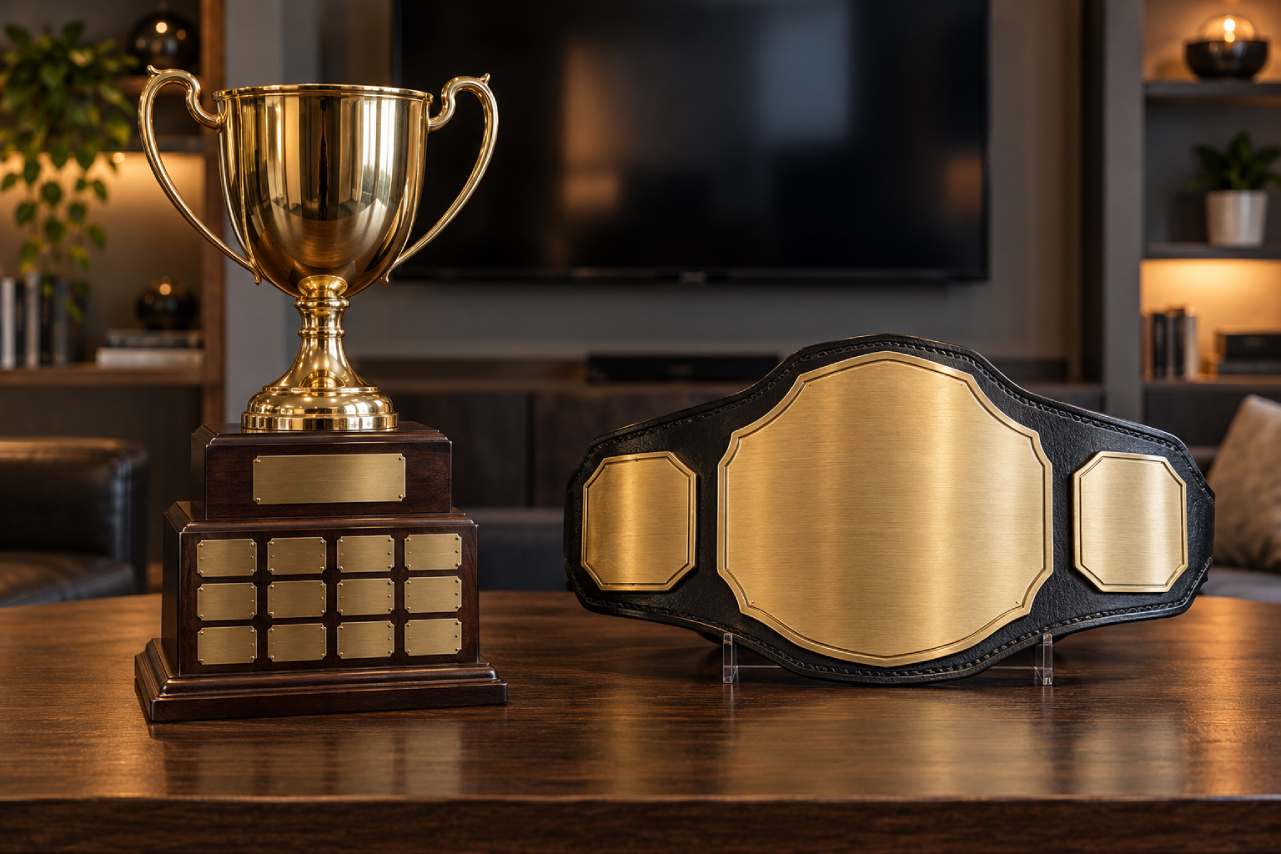
Championship belts have become the second most popular fantasy football prize after the traditional cup, and the debate between them comes up in every league that is upgrading from bragging rights to a physical award. Both work. They work differently, and the differences matter more the longer the league plans to run. This guide compares belts and trophies on the things that actually affect a league, so you can choose once and not revisit it.
The short version
A trophy builds history. A belt builds a moment. If your league expects to run for years and wants a single object that accumulates every champion’s name, choose a perpetual trophy. If your league wants the most fun at the presentation and the best photos, and is fine with the belt being a one-year prize or a rotating one without engraved history, choose a belt. Many leagues eventually do both.
Perpetual tradition
This is where trophies win clearly. A cup on a tiered base with a dozen name plates, like the 15 1/4″ Gold Winged Easy Cup Kit configured with a perpetual base, carries every champion’s name for the life of the league. After five seasons it is a record. After ten it is an heirloom.
Belts have a side plate or two that can be engraved, but the space is limited and most belts are designed as a single-year prize or a rotating one that goes to the current champion without adding a plate each season. Some leagues attach a small engraved tag to the strap each year. It works, but it is not the same as a base full of plates.
Presentation and photos
Belts win here. A belt gets held overhead, worn at the draft, worn to the bar, and photographed from every angle. It is theatrical in a way a cup is not, and it is easier to carry. If your league values the ceremony, the belt is the better prop.
A large trophy can match it. The 18″ NFL Fantasy Football Trophy is tall enough to be its own moment, and a cup held overhead is the oldest sports image there is. But a mid-sized cup on a shelf does not generate the same reaction as a belt around someone’s waist.
Engraving
Trophies have more engraving real estate. A base plate, the cup body, and the perpetual plates. Champion name, team name, year, and the league name all fit, and the trophy engraving guide covers how to lay them out.
Belts engrave on the side plates and sometimes the main plate. Usually enough for the league name and a year, not enough for a decade of champions. If engraved history matters, the trophy is the answer.
Cost
Comparable at the mid range. A quality belt and a mid-sized perpetual cup land in a similar bracket. Belts get expensive quickly at the high end; cups get expensive with size and with the number of perpetual plates. Over a ten-year horizon the trophy is cheaper because the only annual cost is one engraved plate, while some leagues end up buying a new belt when the first one wears out.
Durability
A metal cup on a weighted base lasts indefinitely. A belt has a leather or synthetic strap that wears with handling, and the plates are attached with snaps or screws that loosen. For a league that plans to be around in 2040, the trophy is the safer bet. For a league that treats the prize as a season-by-season thing, durability matters less.
Display
Trophies are made to sit on a shelf. Belts are made to be worn, and they look awkward on a shelf unless mounted in a case. If the champion is going to display the prize at home for a year, the trophy fits the setting better. If the prize is going to live in a bag until the next draft, either works.
Doing both
The most common resolution to this debate is a perpetual cup that stays with the league and records every champion, plus a belt that goes home with the current champion for the year. The cup is the history and the belt is the moment. The fantasy football awards and trophies guide covers how to structure the full prize slate, and the loser trophies guide covers the other end of the standings.
Deciding
Ask the league two questions. How long do we expect this league to run? And what do we care more about, the record or the party? Long-running and record-focused means trophy. Short-horizon and party-focused means belt. Both means both.
How each ages over a decade
Year one, both look great. The belt is the star of the draft party photos; the cup sits on a shelf.
Year three, the cup has three plates with three names and is starting to feel like a record. The belt has been passed three times, the strap shows wear, and one of the side plates has come loose.
Year five, the cup is an institution. Every champion is on it. New members ask about the names. The belt is either retired and replaced or held together with tape and affection.
Year ten, the cup is the most valuable object the league owns and it is discussed in the league’s succession planning. The belt is a memory, or on its second replacement.
That trajectory is why perpetual trophies win the long game. It is also why leagues that love the belt keep buying belts and consider it worth it.
The hybrid setups that work
Perpetual cup stays with the commissioner; belt goes home with the champion. The cup records history; the belt is the annual prize.
Perpetual cup goes home with the champion; a small plaque with all champions stays with the commissioner. Same idea with a plaque as the record.
Belt with an engraved tag added each year. A small engraved metal tag attached to the strap, one per season. Not as elegant as a plate on a base, but it gives the belt history.
Two belts: champion and loser. The loser belt gets more attention. See the loser trophies guide.
Engraving specifics
Cup: header plate with league name and founding year; annual plates with year and champion; optional cup body engraving with the league name for pieces 12 inches and up. See the trophy engraving guide.
Belt: main plate with league name and, if space, “Champion”; side plates with a year or a short line. Most belts arrive with a generic main plate that can be replaced with an engraved one.
Cost over time
A perpetual cup costs the piece plus one engraved plate per year, which is a small annual expense. A belt costs the piece up front and either nothing more or a replacement belt when the first wears out. Over ten years the cup is cheaper for most leagues, and the difference is small enough that it should not decide the question. Choose on tradition versus theater.
Frequently asked questions
Q. Can a belt be engraved with every champion?
In a limited way. Side plates and add-on tags can carry a few years. A cup base carries a decade or more.
Q. Which is better for a new league?
A perpetual cup. It starts building history immediately.
Q. Which is better for a party?
The belt. It is a prop.
Q. Can we have both?
Most leagues that debate this end up with both.
Q. What size cup pairs with a belt?
A 12 to 15 inch cup on a perpetual base. See the trophy size guide.
Sizing the trophy to the league
A ten-team league that has run three seasons and is buying its first perpetual cup should choose a 12-inch cup on a base with at least twelve plates. That covers the horizon and looks right on a shelf. A longer-running league or one that wants the trophy to be a spectacle should go to 15 inches and twenty-four plates. A league that plans to pair the cup with a belt can go slightly smaller on the cup, since the belt carries the presentation. The trophy size guide covers heights and the metal cup trophies buyer’s guide covers the cup families and perpetual base options.
What other leagues have done
Leagues that started with a belt and added a cup later almost always say the cup should have come first, because the early champions are missing from the record. Leagues that started with a cup and added a belt later say the belt made the draft party better and cost nothing in tradition. Leagues that bought a belt, wore it out, and replaced it with a cup wish they had skipped the first belt. The pattern points to cup first, belt second, which is how most long-running leagues end up.
Ordering the trophy side
Viking Awards has engraved trophies in-house since 1973, stocks cups from 8 to 15 inches and the fantasy football trophy above, and can build a perpetual base with the plate count your league needs. The trophy size guide helps with height, and the trophy catalog has every style. Call (630) 833-1733 with the league name and championship date.