
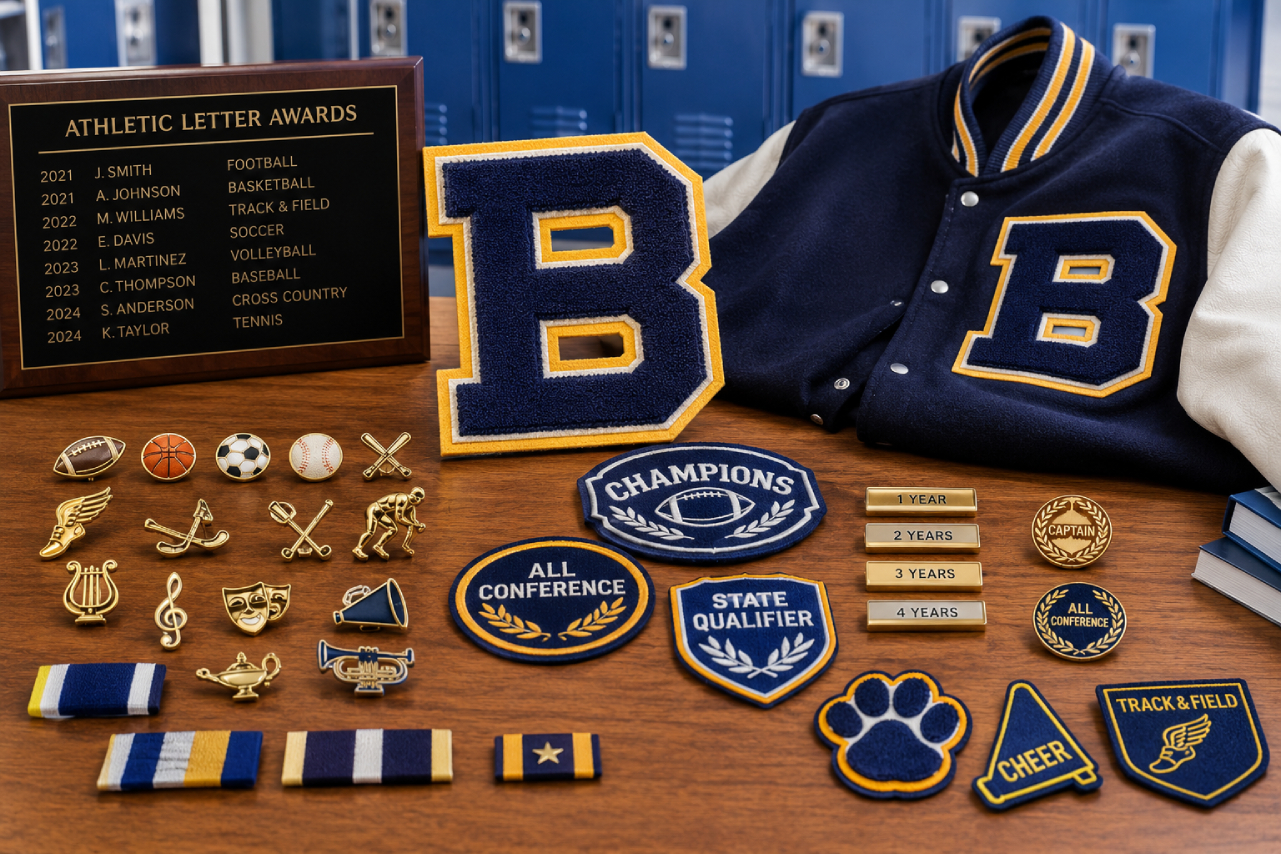
The varsity letter is the oldest form of school athletic recognition still in use, and it works because it accumulates. A student earns the letter once, then adds a sport insignia, a bar for each additional year, and a pin for captaincy or an all conference honor. By graduation the letter jacket tells the whole story. This guide explains the parts of a letter program, what to order for each sport and activity, and how to run the program so it stays consistent from one athletic director to the next.
The parts of a letter award
The chenille letter
The school’s initial in chenille, usually in school colors, sewn onto a jacket or sweater. It is awarded the first time a student meets the letter standard in any sport or activity. Most schools award one letter per student for their career and recognize subsequent achievements with insignia and bars.
Metal sport insignia
A small metal emblem that pins onto the letter to show which sport or activity the letter was earned in. The insignia collection at Viking Awards covers the standard sports and activities, including the gold basketball chenille letter insignia, the gold baseball insignia, the crossed bats insignia for softball, the ice hockey insignia, and the cross country insignia.
Activity insignia
Letters are not only for athletics. Band, choir, drama, academic teams, and cheer all run letter programs. The collection includes the lamp of knowledge insignia for academics, the music lyre and treble clef insignia for music, the jazz insignia, the megaphone and cheerleader insignia for spirit squads, and the band insignia.
Bars and service pins
A bar, usually a small metal strip, is added for each additional year the student letters. Pins mark captaincy, all conference or all state honors, or a specific achievement like a school record.
Chenille patches
Beyond the letter, chenille patches for championships, all conference, and individual honors are sewn onto the jacket. The apparel and patches collection covers these.
The jacket
The letter jacket itself is typically purchased by the family, though some schools provide it. The school provides the letter and insignia.
Setting the letter standard
Every school decides what earns a letter, and the standard should be written down and published. Common approaches:
- Participation in a set percentage of varsity contests, often half.
- Completing the season in good standing with the team.
- Meeting a performance threshold, such as scoring in a certain number of meets for individual sports.
- A coach’s discretion for injured athletes who would otherwise have met the standard.
- An academic requirement, since many schools tie eligibility to GPA.
The standard should be the same across sports in spirit even if the specifics differ. A letter that is easy in one sport and hard in another loses meaning.
What to order each season
An athletic director orders once per season or once per year, depending on how the school presents letters. A typical order for a season:
- One chenille letter for every first time letter winner across all sports that season.
- One sport insignia for every letter winner in each sport, including repeat winners who are adding a new sport.
- One bar for every repeat letter winner in the same sport.
- Captain pins, all conference pins, or other honor pins as earned.
- Championship patches if a team won a title.
- A small reserve of each item for late eligibility decisions and replacements.
The counts come from coaches’ end of season reports, so the athletic office should have a form coaches fill out that lists first time letter winners, repeat winners, and honors by name.
Presentation
Letters are usually presented at a seasonal awards night rather than mailed. The presentation matters most for first time winners, so call them individually. Repeat winners and bar recipients can be recognized as a group. Some schools present letters at an all sports banquet at the end of the year, which concentrates the recognition but delays it for fall athletes.
A nice practice is to pair the letter with a small plaque or certificate for seniors, and to recognize four year letter winners separately with a walnut plaque or a crystal piece. A perpetual plaque in the athletic hallway listing multi sport letter winners by year is a tradition worth starting.
Keeping the program consistent
Letter programs fail when they are reinvented by each new athletic director. A short written document that states the letter standard, the items awarded, the supplier, and the presentation format keeps the program stable. Keep the letter color, chenille style, and insignia finish the same year to year so a senior’s jacket matches a freshman’s.
Order from a supplier that stocks the items you use so a mid year replacement or a late addition is a phone call rather than a special order. Viking Awards stocks chenille letters, the full insignia line, bars, and pins and can turn a replacement in days.
Cost
Letter programs are among the least expensive recognition a school runs. Insignia and bars cost very little per piece, and chenille letters are modest. The expense is the jacket, which is the family’s. For a school with 300 athletes, the annual letter program budget is typically a small fraction of what the same school spends on trophies and plaques, which is one reason the tradition has lasted.
Related reading
For medals and plaques that complement a letter program, see best medals for high school awards ceremonies and walnut plaques for schools. The awards for schools guide covers the full range of school recognition, and the sports awards guide links to every sport.
Insignia by sport and activity
Matching the insignia to the activity is part of what makes the letter program feel complete. The standard metal insignia line covers the major sports, including football, basketball, baseball, softball, soccer, volleyball, wrestling, track, cross country, swimming, golf, tennis, and hockey, plus activities such as band, choir, orchestra, jazz, drama, cheer, academics, and student government. For sports or clubs without a dedicated insignia, a generic laurel or a lamp of knowledge is the conventional substitute.
Schools that run letter programs for a large number of activities sometimes adopt a simple rule: every activity that meets for a full season and competes or performs publicly is eligible for a letter. That keeps the program fair and avoids a yearly argument about which clubs qualify.
A sample annual calendar
Late summer: review the letter standard with coaches and confirm the supplier has stock of the school’s letter and insignia.
End of fall season: coaches submit letter reports. Athletic office compiles the order and sends it. Fall awards night follows two to three weeks later.
End of winter season: same process. Winter awards night.
End of spring season: same process, plus senior recognition and four year letter winner plaques. Spring or all sports awards night.
Summer: order a reserve of letters, insignia, and bars for the next year, and update the written program document with any changes.
Replacements and lost items
Students lose insignia and bars, and jackets get outgrown. Keep a small supply of each in the athletic office so a replacement is immediate. A chenille letter replacement is a special order but takes only days from a supplier that stocks them. Charging a small replacement fee is common and reasonable.
Letters beyond high school
Middle schools, club teams, and some colleges run letter programs too. The components are the same, scaled to the program. A club soccer organization might award a club letter with a year bar for each season, which gives long tenured players something to show for it that a stack of medals does not.
Recognizing the letter winner who is not an athlete
Schools sometimes hesitate to award letters to band, drama, or academic team members because the tradition feels athletic. The letter is a recognition of commitment to a school activity over a season, and a trombone player who rehearses every afternoon and performs at every football game has met that standard as surely as a lineman. Treating activity letters with the same seriousness as athletic letters, with the same ceremony and the same insignia quality, is the simplest way a school can tell its students that all of their effort counts. Many schools find that activity letter programs also raise participation, because students see a tangible reason to stay with an ensemble or a team for four years.
The letter jacket a student wears at graduation is, for many of them, the most complete record of their high school years they will ever own. That is reason enough to run the program carefully.
Where to order
Viking Awards in Westchester, Illinois has supplied schools across the Chicago area and nationwide since 1973 and stocks chenille letters, metal sport and activity insignia, bars, pins, and patches. Athletic directors can send a season’s counts and have the order ready for the awards night, with replacements available on short notice. Call 630-833-1733 or use the contact page.