
Crystal awards are the premium tier of recognition, and the engraving is a large part of why. A crystal piece with a logo floating inside it, or a name etched to a frosted finish that catches light from every angle, communicates something that a plaque does not. Crystal engraving is also more technical than engraving on other materials, and the results vary widely depending on the process and the piece. This guide explains the two main methods, what each looks like, what artwork works, and what to expect on turnaround and cost.
Two kinds of crystal engraving
Subsurface laser engraving
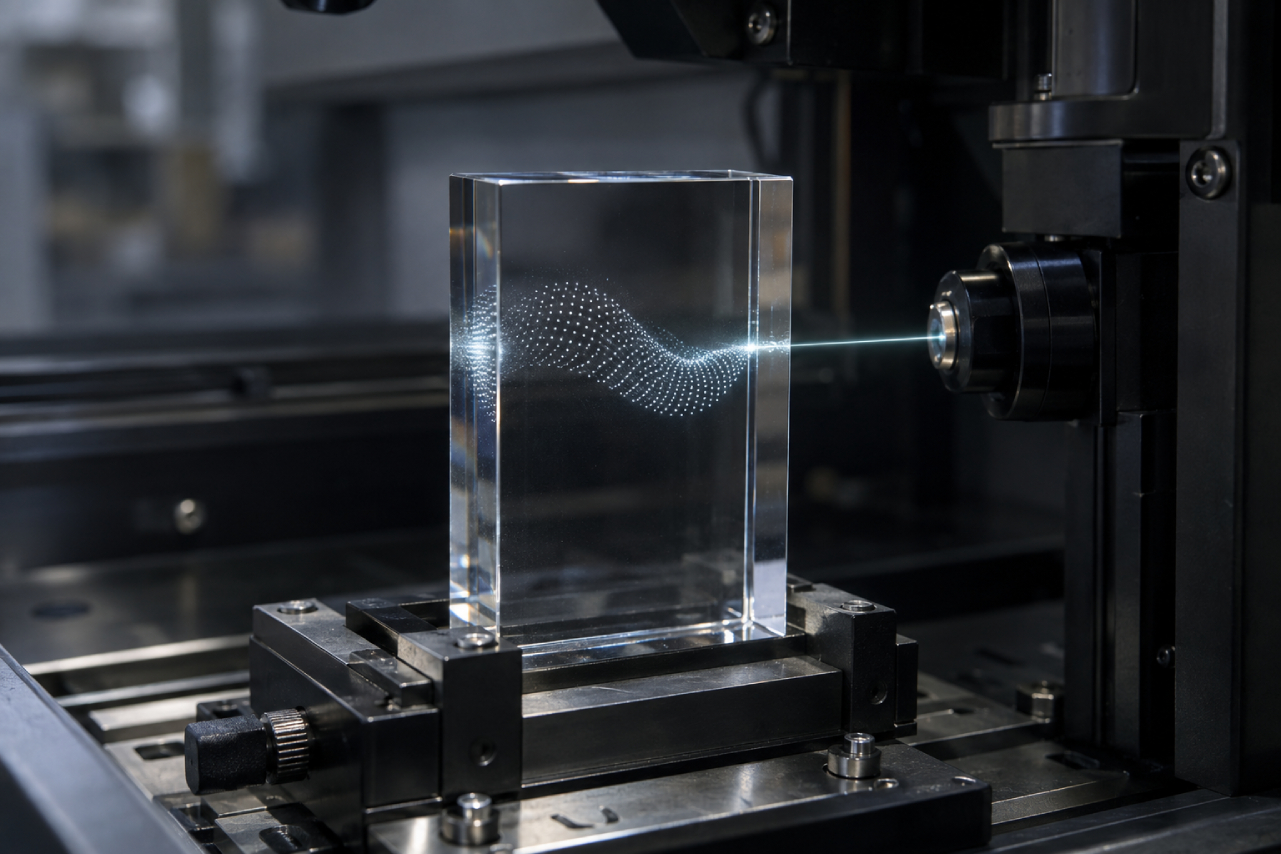
This is the process that produces images floating inside the crystal. A laser is focused to a point below the surface, where it creates a tiny fracture. Thousands of those points build a three-dimensional image inside the piece with the outer surface untouched. Logos, text, photographs, and even 3D objects can be rendered this way. It only works in optical crystal, which is manufactured to be flawless enough to focus a laser through. The optical crystal awards guide explains what optical crystal is and why it matters.
Subsurface engraving is what makes pieces like the diamond series crystal trophy with cobalt base and the crystal obelisk with prism-effect base read as premium. The image has depth, it is visible from multiple angles, and it cannot be scratched off.
Surface engraving
Surface engraving on crystal or glass uses a laser or sandblasting to frost the outer surface. The result is a matte white mark on the clear material, which reads clearly and is the same look you see on engraved glass awards. It works on any crystal or glass, not just optical grade, and it is the standard method for text on bases, flat panels, and simpler pieces like the crystal cube on a black crystal base.
Surface engraving can also be color-filled, which is common for logos that need to appear in brand colors.
What each looks like
Subsurface produces a bright, slightly sparkling image that appears to hang in space inside the crystal. It photographs beautifully and it is the effect most people picture when they think of a crystal award. It is best for logos, portraits, and 3D renderings. Fine text works but very small text can lose definition.
Surface produces a crisp frosted mark that reads like etched glass. It is best for text, simple logos, and any application where legibility at a glance matters more than dimensional effect. It is also the only option on non-optical crystal and on glass.
Many premium awards use both: a subsurface logo in the body and surface-engraved text on the base.
Artwork requirements
For subsurface engraving, a vector logo produces the cleanest result. Photographs work and are converted to a point cloud; higher resolution and good contrast make a difference. For 3D engraving, a 3D model file is needed, or the shop can generate one from photographs for an additional charge.
For surface engraving, vector files are strongly preferred. Raster images can be used but produce a halftone effect. Text should be supplied as text, not as an image, so the shop can set it cleanly.
Confirm placement. Crystal pieces have faces, edges, and bases, and the engraving location changes how the piece reads. A good shop will show you the options on the proof.
What to write
Crystal awards typically carry less text than plaques because the format is about the piece, not the citation. Organization, award name, recipient, and date are usually enough. A logo above the text is standard for corporate pieces. Our award engraving wording guide has phrasing examples, and the crystal awards with engraving guide covers how to choose a piece and pair it with the right text.
Turnaround
Crystal engraving takes longer than engraving on most other materials. Subsurface work is slower to run and the pieces are frequently ordered in rather than stocked. Plan seven to fourteen business days for standard orders and confirm with the shop before committing to a date. Surface engraving on stocked crystal and glass can be faster. Crystal is not a same-day category; see the same-day and rush engraving guide for what is.
Cost
Crystal engraving is priced higher than engraving on plaques or acrylic because the material is premium and subsurface work is slower. The piece itself is usually the larger part of the cost. Logos and photographs add setup; 3D renderings add more. Quantity brings the per-piece cost down. The engraving cost guide covers typical ranges.
Crystal engraving by piece type
Freestanding pieces like obelisks, flames, and diamonds take a subsurface logo in the upper body and surface text on the base or a lower face. The logo is the visual focus; the text is the record.
Cubes and blocks put the engraving front and center. A subsurface logo in the block with surface text below, or surface engraving of both on the front face. The crystal cube is a common corporate format for this reason.
Paperweights and small desk pieces, like the crystal cube paperweight, take short text or a small logo and suit bulk recognition and client gifts.
Pieces with colored bases, like the 10″ crystal diamond on a blue base, typically take text on the clear upright rather than the colored base, where contrast is lower.
Sport-shaped crystal, like a golf ball or soccer ball, takes text on the base and sometimes a small logo on a flat facet.
Subsurface engraving in depth
The laser is focused to a point inside the crystal, where the energy is concentrated enough to create a tiny fracture. The surface is untouched because the beam is not focused there. Thousands of these points, each positioned in three dimensions, build up the image. For a logo or text, the points sit on a single plane inside the piece. For a 3D rendering, they occupy a volume.
Point density controls how bright and solid the image appears. Fine detail requires dense points; large areas can use sparser ones. A skilled shop tunes this per piece. The image is brightest when lit from below or behind, which is why many crystal awards come with or are displayed on a lighted base.
Subsurface engraving is permanent and cannot be scratched, worn, or removed.
Surface engraving in depth
A laser or a sandblasting process frosts the crystal or glass surface, producing a matte white mark against the clear material. Laser is faster and more precise for text and fine logos; sandblasting produces a deeper frost and is used for larger areas and pieces where a more tactile mark is wanted.
Surface engraving can be color-filled with paint or enamel, which is how brand colors appear on glass awards. The fill sits in the frosted recess and is durable under normal handling.
Text sizing on crystal
Surface text should be at least an eighth of an inch high to read clearly; larger on pieces that will be viewed from a shelf. Subsurface text can be smaller because it is bright against the clear background, but very small subsurface text can lose definition. When a piece needs a lot of text, the base is the place for it, at a legible size.
Common crystal engraving mistakes
Supplying a low-resolution logo. Subsurface engraving reproduces exactly what it is given; a fuzzy logo becomes a fuzzy image inside the piece, permanently.
Putting text on a curved or faceted surface. Flat faces engrave cleanly; curved and faceted ones distort. The proof will show which faces are usable.
Too much text. Crystal is about the piece. Four lines is plenty.
Ordering crystal on a short deadline. The process takes time. See the custom award turnaround guide.
Frequently asked questions
Q. Can subsurface engraving be done on glass?
No. It requires optical crystal. Glass takes surface engraving only. See the optical crystal vs regular crystal guide.
Q. Can a photograph be engraved inside crystal?
Yes. It is converted to a point cloud and rendered as a 2D image inside the piece. Portraits and pet photographs are common.
Q. Can the engraving be seen from all sides?
Subsurface, yes. Surface, from the engraved face and at an angle.
Q. Is crystal engraving expensive?
More than plaque engraving, less than the piece itself. The engraving cost guide has ranges.
Ordering checklist for crystal
The piece, chosen from the crystal awards catalog with the shape matched to the occasion. Confirmation that it is optical crystal if subsurface engraving is wanted. A vector logo. The text, four lines or fewer, checked by two people. The placement, confirmed on the proof. The date, with at least two weeks of production allowed. Whether a lighted base or presentation box is wanted. Ship-to address and a person to receive it, or pickup.
With those eight items, a crystal order runs cleanly from quote to delivery.
Crystal engraving at Viking Awards
Viking Awards engraves crystal in-house at its Westchester, Illinois shop and stocks a deep crystal awards catalog covering diamonds, obelisks, flames, globes, cubes, and columns. The team handles both subsurface and surface work, sends a proof showing placement and artwork before production, and can advise on which piece suits the occasion. Call (630) 833-1733 with the artwork and date, or see the engraving gallery for finished crystal examples. For the full range of materials the shop engraves, see the custom engraving services guide.