
Indoor memorial plaques have it easy. Outdoor plaques face sun, rain, freezing winters, lawn equipment, and decades of handling, and most of the plaques that fail do so because they were never meant to be outside. A memorial on a park bench or under a tree needs the right material, the right mounting, and text sized to be read from standing height. This guide covers what works outdoors, by setting, and what to avoid.
Materials that survive outdoors
Cast bronze
The standard for permanent outdoor memorials. Bronze is cast with raised letters and a recessed background, develops a protective patina, and lasts a century or more. It is the material on park benches, building dedications, and cemetery markers because nothing else matches its durability. It is also the most expensive and the slowest to produce, at three to six weeks. The cast bronze plaques guide covers the process in detail.
Brass
Engraved brass holds up well outdoors with a clear coat and is faster and less expensive than cast bronze. It is the common choice for bench plates and tree markers where cast bronze is more than the setting requires. Expect it to darken gradually; some people prefer that.
Aluminum
Anodized or powder-coated aluminum engraves cleanly, resists corrosion, and is the lightest option. It suits garden markers, trail signs, and memorials in wet climates. It does not have the weight or presence of bronze.
Stainless steel
Durable and modern-looking, but engraving contrast is lower than on bronze or brass. Used for contemporary memorials and architectural settings.
What to avoid
Standard plastic plates, uncoated wood, acrylic, and any material designed for indoor plaques. They fade, crack, or delaminate within a few seasons. A walnut plaque is a beautiful indoor memorial and a poor outdoor one.
By setting
Bench plaques
Benches take a plate mounted on the top rail or the backrest, typically 2 by 8 inches or 3 by 10. Brass or cast bronze. The plate should be read by someone standing in front of the bench, so text of at least a quarter inch high. Three lines is the practical limit at that size. See the memorial plaque wording guide for bench-specific text.
Tree and garden markers
Small plates, usually 2 by 4 to 4 by 6, on a stake or a small stone. Aluminum or brass. Text is short: name, dates, one phrase. Mount at knee height or on a low stone so mowers clear it.
Building and entrance plaques
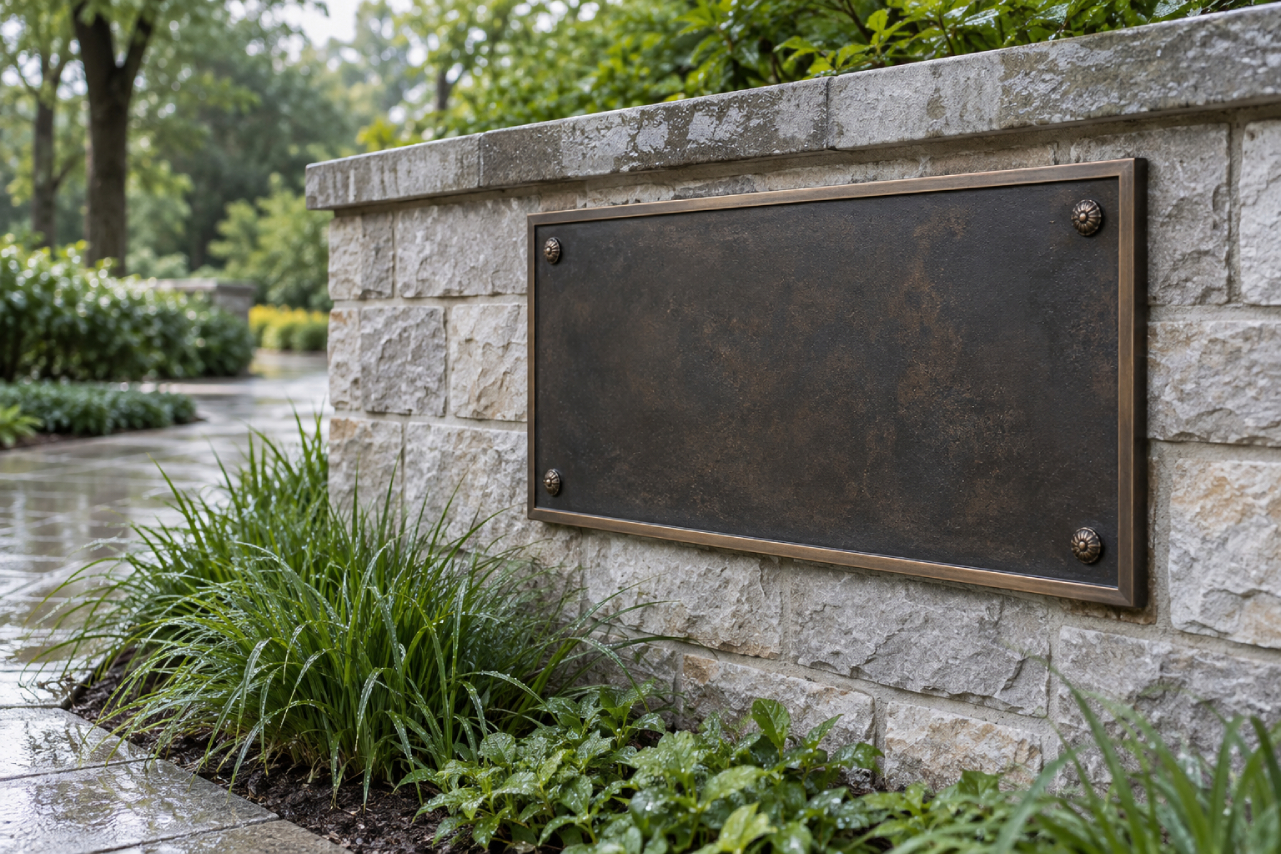
Wall-mounted, 8 by 10 and larger. Cast bronze is the standard; brass on a backing plate is the alternative. These carry more text and often an organization name and date. The dedication plaques guide covers formats.
Memorial walls and donor walls
Multiple plates on a shared wall, often in a garden or courtyard. Uniform size and material across all plates; brass or bronze. Plan the grid before ordering the first plate so later additions match.
Cemetery and grave markers
A category with its own regulations, and most cemeteries specify the material and size. Cast bronze on granite is typical. Check with the cemetery before ordering.
Sizing text for outdoors
Text on an outdoor plaque is read from further away than indoor text. Minimum letter height of a quarter inch for bench and tree plates; half an inch for wall plaques read from a path. Fewer lines, larger letters. A plaque that looks generous on a desk looks small on a bench.
Mounting
Bench and rail plates mount with screws or rivets through pre-drilled holes. Wall plaques mount with concealed studs or exposed rosette screws. Garden markers come on stakes or are set in a stone. Ask the supplier for the mounting hardware appropriate to the setting; a plaque that falls off in the first winter is a plaque that was mounted wrong.
Wording
Outdoor memorials carry less text than indoor ones. Name, dates, and a single phrase. “In loving memory of.” “Dedicated to.” “Planted in memory of.” The memorial plaque wording guide has examples by setting, and the memorial plaque ideas guide covers designs and materials for every context. For indoor placement, see the memorial wall plaques guide.
Timeline
Brass and aluminum plates engrave in a few days. Cast bronze takes three to six weeks. If the memorial is tied to a date, order cast bronze two months out. The custom award turnaround guide covers timelines by product.
Cast bronze in detail
Cast bronze plaques are made by creating a pattern with raised lettering, casting molten bronze into a mold from that pattern, and finishing the surface. The lettering is raised and the background is recessed and textured, usually in a dark oxidized finish that makes the polished letters stand out. The result is the plaque style on park benches, historical markers, and building dedications everywhere.
Bronze is expensive because the process is manual and the material is costly. It is also the only plaque material that reliably lasts a century outdoors without maintenance. For a memorial meant to be permanent, it is the right choice. The cast bronze plaques guide covers sizes, borders, and ordering.
Brass and aluminum in detail
Engraved brass plates are cut from sheet stock, engraved with rotary or laser equipment, and clear-coated. They install with screws through drilled holes or with adhesive on a backing. Brass darkens over years outdoors; the clear coat slows this. It is the right choice for bench and tree plates where cast bronze is more than the setting calls for.
Aluminum plates are anodized or powder-coated and laser-engraved. They do not corrode, they are light, and they are the least expensive outdoor option. The engraved mark on black-anodized aluminum is bright and legible. Aluminum is the right choice for garden markers, trail signs, and memorials in coastal or wet climates.
Sizing by setting
Bench top rail: 2 by 8 or 2 by 10 inches. Bench backrest: 3 by 10 or 4 by 12. Tree stake: 2 by 4 to 4 by 6. Garden stone: 4 by 6 to 6 by 8. Wall dedication: 8 by 10 to 12 by 18. Donor wall plates: uniform, typically 2 by 6 or 3 by 8.
Order the size the mounting surface allows and the text requires, in that order. A plaque that overhangs a bench rail looks wrong and catches on things.
Working with parks and municipalities
Most public bench and tree memorials go through a parks department or a friends-of-the-park foundation. They typically specify the plaque size and material, sometimes the supplier, and handle installation. Ask before ordering. A plaque that does not meet the program’s specification will not be installed.
Maintenance
Cast bronze needs nothing; the patina is protective. Clear-coated brass benefits from a wipe with a soft cloth once or twice a year; do not polish, which removes the coat. Anodized aluminum needs only occasional cleaning. Check mounting hardware annually, especially on benches that are moved for maintenance.
Frequently asked questions
Q. How long does cast bronze last?
Generations. It is the material on markers from the 1800s that are still legible.
Q. Can a photo be included on an outdoor plaque?
On cast bronze, as a bas-relief portrait, at significant cost. On aluminum, as a laser-engraved halftone that will hold up for years. On brass, not well.
Q. Can an outdoor plaque be engraved on both sides?
Bench and stake plates can, though the back is rarely visible. Wall plaques cannot.
Q. What about vandalism and theft?
Cast bronze on a bench is occasionally stolen for scrap. Tamper-resistant mounting hardware reduces the risk. Brass and aluminum are rarely targeted.
Q. How do I choose between bronze and brass for a bench?
Bronze if the memorial is meant to outlast everyone who knew the person. Brass if it is meant to last decades and the budget matters. Both are appropriate.
Ordering timeline by material
Aluminum or brass plate: order two weeks before installation. Production is days; the buffer covers the proof and shipping.
Cast bronze: order eight weeks before installation. Production is three to six weeks and the proof stage for a cast plaque is more involved, since the pattern must be approved before casting.
Any plaque going through a parks program: add the program’s approval time, which can be weeks.
For a memorial tied to an anniversary or a service, work back from the date and add a week. The custom award turnaround guide covers timelines by product type.
When the date cannot move and the timeline is short, install a brass or aluminum plate for the service and replace it with cast bronze afterward. Many families do exactly this.
Ordering
Viking Awards has produced memorial plaques since 1973, engraves brass and aluminum in-house at its Westchester, Illinois shop, and handles cast bronze orders with the mounting hardware for the setting. The team will help with wording and sizing before sending a proof. Browse the plaques catalog or call (630) 833-1733 with the setting, the text, and the date. For a broader look at plaque formats, see the custom plaques guide.