
A plaque is the most flexible recognition format there is. It hangs on a wall, sits on a desk, holds a long message, carries a logo, and lasts decades. Almost all of that comes down to the engraving. This guide covers how plaques are engraved, the plate and material options, how to lay out text so it reads well, what to write, and how to order without a revision cycle.
How plaques are engraved
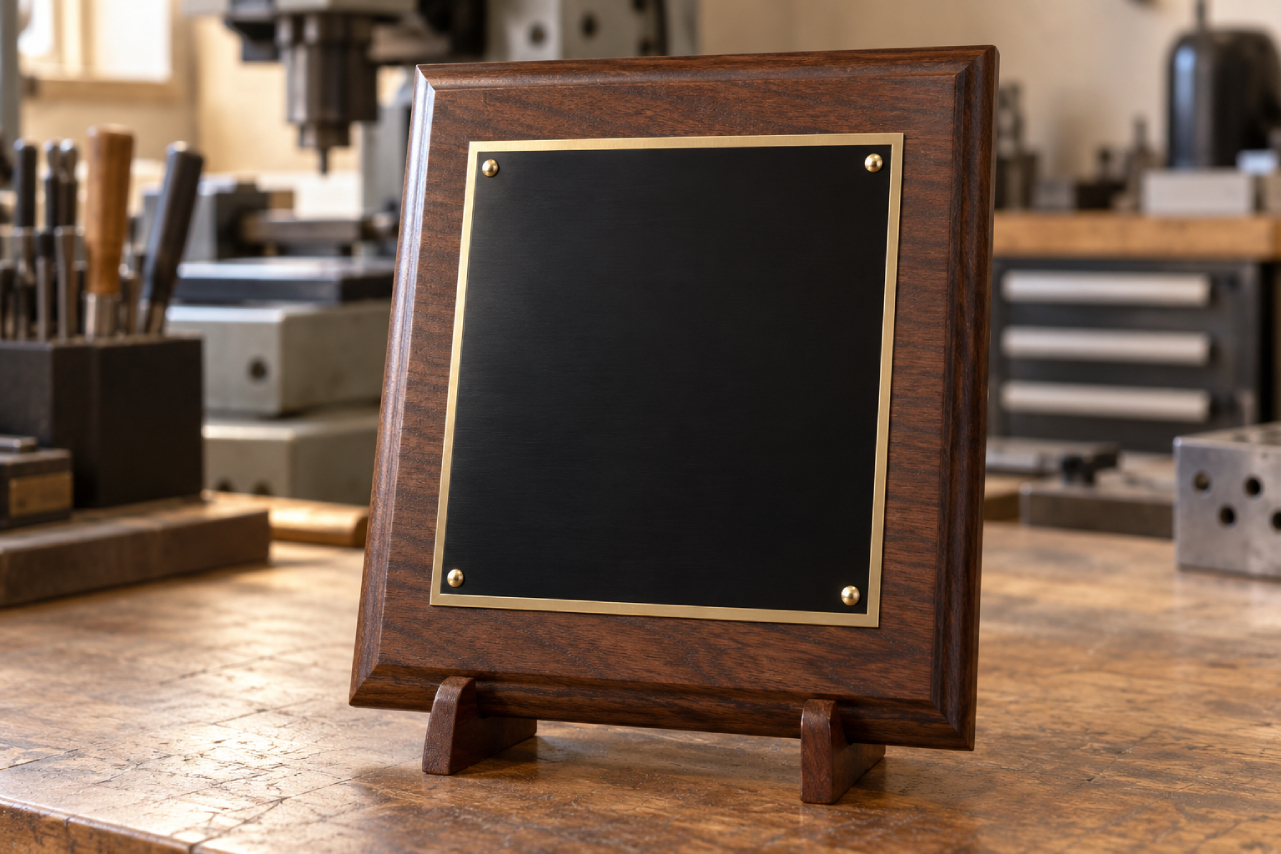
There are two approaches. The first is an engraved plate mounted on a plaque board. The plate is brass, aluminum, or plastic, engraved with the text, and attached to a walnut, cherry, or high-gloss board. This is the standard for most recognition plaques because the plate engraves crisply, the board provides the presence, and the two can be mixed and matched. The walnut plaque with a black brass plate is this format.
The second is direct engraving on the plaque material itself. Wood, acrylic, glass, and stone can all be engraved directly, which produces a cleaner single-material look and is common for modern acrylic plaques and rustic wood signs. The high gloss plaques guide and the custom wood engraving guide cover direct engraving on those materials.
Cast bronze plaques are a third category with their own process, where the text is raised rather than engraved. See the cast bronze plaques guide.
Plate options
Black brass with gold-tone engraving is the most traditional and the most legible from a distance. The walnut plaque with black engraving plate and gold border is the classic combination.
Gold or silver brass with black engraving reads as formal and is common on executive and institutional plaques.
Florentine-bordered plates add a decorative frame and are typical on the black high-gloss plaque with gold florentine border.
Acrylic plates engrave to a frosted mark and suit contemporary designs.
Marble-finish and colored plates, like the blue marble finish plaque, offer color without a separate plate.
Perpetual plaques carry a header plate plus a grid of small individual plates for annual recipients. The walnut perpetual plaque with 12 plates and 24 plates are the standard configurations.
Layout rules that make plaques read well
Hierarchy first. The most important line, usually the award title or the recipient’s name, should be largest. Everything else steps down.
Fewer lines, more space. A plaque with five well-spaced lines reads better than one with nine cramped ones. If you have a lot to say, use a larger plaque or a larger plate rather than a smaller font.
Logo at the top or the bottom, not the middle. A logo in the center of the text block breaks the reading flow.
Match the case. All caps for the title line, mixed case for body text, and consistent formatting for dates.
Leave margins. Text should not run to the edge of the plate. A quarter inch minimum on standard plates.
Center for formal, left-align for long text. Centered layouts suit short recognition text. Left-aligned layouts suit longer citations and memorial text.
What to write
Recognition plaques typically carry the organization, the award name, the recipient, a short citation, and the date. Retirement and service plaques add years of service. Dedication and memorial plaques carry a name, dates, and a line of tribute. Donor plaques carry the donor name and, often, the giving level.
Our award engraving wording guide has phrasing for each of those categories, and the memorial plaque wording guide covers memorial text specifically. The single most useful rule is to write the plaque as if it will be read by someone who was not there. Names, the reason, and the date. Everything else is optional.
Fonts
Serif fonts read as traditional and suit brass plates and walnut boards. Sans-serif fonts read as modern and suit acrylic and high-gloss. Script fonts work for a single line, usually a name, and not for body text. Whatever you choose, use no more than two fonts on a plaque.
Proofs and revisions
Any shop engraving a plaque should send a proof showing the exact layout before production. Review it for spelling, dates, and hierarchy. Once a plate is engraved it cannot be corrected, so this is the step that matters. Have a second person check names and dates.
Turnaround and cost
Standard plaques with plate engraving turn around in two to five business days at a shop that engraves in-house, and single plaques are often same-day if the board is in stock. See the same-day and rush engraving guide. Cost is driven by the plaque size and material more than by the engraving, which is usually a modest flat fee covering several lines. Logos add a small setup charge. The engraving cost guide has typical ranges.
Plaque engraving by occasion
Service and tenure recognition takes the organization name, the recipient, the years of service, and a line of thanks. See the years of service awards guide for milestone tiers.
Retirement takes the same structure with a warmer line. The retirement plaque wording guide has examples by tone.
Achievement and performance awards take the award name, the recipient, the year, and optionally the metric.
Dedication plaques take the space or object being dedicated, who it honors, who dedicated it, and the date. The dedication plaques guide covers formats.
Memorial plaques take the name, dates, and a phrase. The memorial plaque wording guide has examples by setting.
Donor recognition takes the donor name and, optionally, the giving level or the fund. The donor recognition plaques guide covers walls and tiers.
Perpetual awards take a header plate engraved once and annual plates engraved as each recipient is named.
Plaque sizes and what fits
A 5 by 7 plaque holds three to four lines. A 7 by 9 holds four to six. An 8 by 10 holds five to seven. A 9 by 12 holds six to eight plus a logo. A 12 by 15 holds a full citation paragraph. These are legible-size estimates; more will physically fit at a smaller font, but the plaque stops reading well from a normal distance. If the text is long, size up the plaque rather than down the font.
Logos on plaques
A logo can go on the plate, engraved above the text, or directly on the board above the plate. On the plate is simpler and keeps everything in one engraving pass. On the board is more distinctive and works well on walnut and high-gloss. Either way, supply a vector file. A logo redrawn from a low-resolution image is never quite right.
Color logos on plaques are done by sublimation on a coated plate, which reproduces the full color. See the types of engraving comparison.
Common plaque engraving mistakes
Too many lines. The single most common problem. A plaque that tries to tell the whole story becomes unreadable.
Inconsistent formatting across a set. Ten plaques for ten recipients should share a layout. Variation looks like carelessness.
Dates in mixed formats. “March 2026” on one line and “3/26” on another.
Approving the proof without reading it. The proof exists to catch errors. Read every word.
Choosing the plate color to match the text rather than the board. Gold plates on walnut, black plates on high-gloss, silver on contemporary boards. The plate should suit the board first.
Frequently asked questions
Q. Can the plate be replaced later?
Yes. Plates are attached with adhesive or screws and can be swapped. This is how errors are fixed and how perpetual plaques are updated.
Q. How long does a plaque take?
Two to five days for a stock board with plate engraving; often same-day for a single plaque. See the same-day and rush engraving guide.
Q. Can a photograph go on a plaque?
Yes, sublimated on a coated plate in full color, or laser-engraved as a halftone on a wood or metal surface. The photo or certificate plaque is built for this.
Q. Can I bring my own plaque board?
Yes, if the plate area is flat and the board is in usable condition. The shop will engrave a plate to fit.
Q. What is the most durable plaque for a busy hallway?
A walnut or high-gloss board with a brass plate, mounted with screws. Acrylic scratches; bare wood dents.
Perpetual plaque engraving
Perpetual plaques carry a header plate and a grid of smaller plates, and the engraving on each part follows different rules. The header carries the award name, the organization, and the founding year, engraved once and formally. The individual plates carry the year and the recipient, in a format that stays identical for the life of the plaque. Decide the plate format before the first one is engraved: year first or name first, first and last name or initial and last, team name or manager name. Once the first plate is on, every subsequent plate must match. Ordering the plaque with all plates blank and engraving them annually is the standard approach; a shop that keeps the layout on file makes each year’s plate a phone call. The perpetual trophies vs perpetual plaques guide covers when a plaque is the right perpetual format.
Plaque engraving at Viking Awards
Viking Awards has been engraving plaques in-house since 1973 and stocks walnut, cherry, high-gloss, acrylic, and marble-finish boards with every plate style above. The team lays out the text, sends a proof, and engraves at the Westchester, Illinois shop. Browse the plaques catalog, see finished examples in the engraving gallery, or call (630) 833-1733 with your text and the occasion. For the full picture of what the shop engraves, see the custom engraving services guide.