
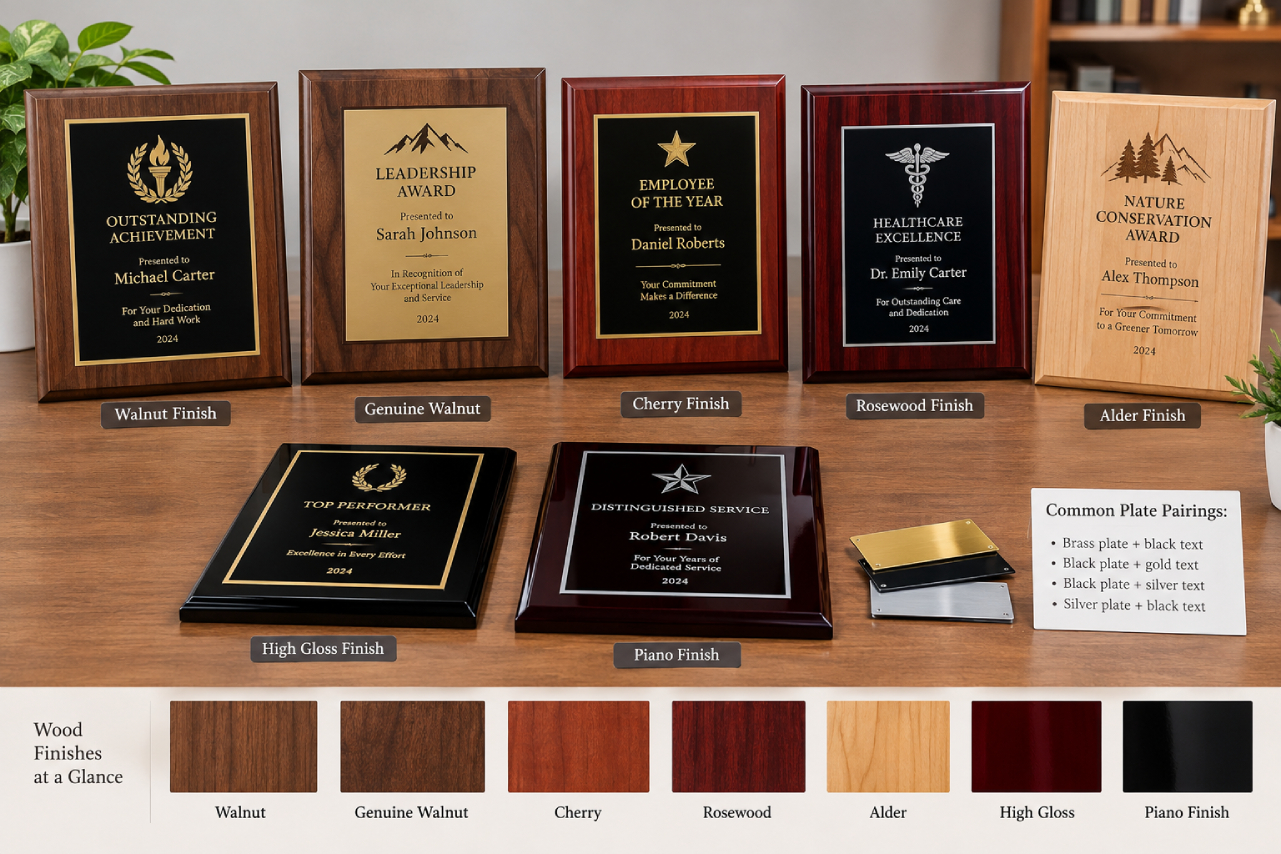
Choosing a plaque size sounds like the easy part, until the proof comes back and the recipient's name is in 14 point type because the citation was too long, or the plaque arrives and looks lost on a large office wall. Plaque size decides how much you can say, how readable it is, and how the plaque looks where it hangs. This guide walks through the standard plaque sizes, how much text fits on each, which size suits which kind of award, and how to choose without guessing.
How plaque sizes are measured
Plaque sizes are given as width by height in inches, for a vertical plaque. A 9 by 12 plaque is 9 inches wide and 12 inches tall. Most plaques can also hang horizontally, in which case the same plaque is 12 inches wide and 9 inches tall.
The engraving plate is smaller than the board. A 9 by 12 plaque typically carries a plate around 7 by 10, leaving a border of wood around the plate. The plate size, not the board size, determines how much text fits.
Standard plaque sizes
6 by 8
The smallest common award plaque. Suits certificates of completion, small team awards, participation recognition, and anything given in quantity. A 6 by 8 step edge genuine walnut plaque or a 6 by 8 genuine red alder plaque is typical. Plan on four or five short lines of text.
7 by 9
The most popular size for individual awards. Large enough for a name, an award title, a date, a logo, and one line of citation, but small enough for a desk or a crowded office wall. Examples include the 7 by 9 American walnut plaque with a sapphire marble LaserFX plate and the 7 by 9 elliptical edge genuine walnut plaque. Plan on five to seven lines.
8 by 10
A step up in presence. Suits coaches awards, service anniversaries, and retirement plaques with a short citation. The 8 by 10 genuine walnut plaque with a scroll frame and the 8 by 10 natural alder plaque with a Florentine bordered plate are common. Plan on six to eight lines.
9 by 12
The size for awards that carry real words. Retirement plaques with a full citation, memorial and dedication plaques, and executive recognition. The 9 by 12 piano finish floating acrylic plaque and the 9 by 12 genuine red alder plaque suit this use. Plan on eight to twelve lines.
10 1/2 by 13
A formal size that reads as a significant honor. Lifetime achievement, hall of fame, and senior executive retirement. The 10 1/2 by 13 step edge genuine walnut plaque and the 10 1/2 by 13 piano finish floating acrylic plaque are examples. Plan on ten to fourteen lines, or fewer lines at a larger size.
11 by 15 and larger
The largest standard individual plaque. Suits lobby displays, building dedications, and awards that include a photograph alongside the text. The 11 by 15 genuine walnut plaque with a scroll frame and the 11 by 15 rosewood high gloss plaque are typical.
Perpetual and roster plaques
Plaques with many small plates are sized by plate count rather than by text. A 12 plate perpetual plaque is roughly the size of a large individual plaque, while a 102 plate perpetual plaque is a wall piece. The roster plaques guide covers team plaques by plate count.
Quick reference: size by occasion
Participation, certificates, small team awards: 6 by 8.
Employee of the month, coaches awards, school honors: 7 by 9.
Service anniversaries, sales awards, short retirement plaques: 8 by 10.
Retirement with citation, memorial, dedication, donor recognition: 9 by 12.
Hall of fame, lifetime achievement, executive retirement: 10 1/2 by 13.
Lobby displays, building dedications, photo plaques: 11 by 15 or larger.
Annual winners over many years: perpetual plaque sized by plate count.
How much text fits
The honest answer depends on font size, so think in lines rather than words. A line on a plaque is typically 20 to 35 characters for a standard size. Here is a practical guide for a plate with readable text:
Headline (award title or recipient name): one or two lines at a large size.
Body (citation, dates, organization): smaller lines below.
Logo: usually occupies the space of two or three lines.
If your text runs longer than the size allows, the shop will shrink the font. Below a certain size, the plaque becomes hard to read from more than a few feet away. When the proof shows small text, the right move is usually to cut words, not to accept the small type. If the words cannot be cut, step up a size. The plaque engraving guide and the award engraving wording guide have examples of text that fits well.
Choosing a size for the space
Think about where the plaque will hang.
A desk or a shelf suits 6 by 8 or 7 by 9, often with an easel back so it can stand.
A private office wall suits 7 by 9 to 9 by 12. Larger plaques can dominate a small office.
A hallway or lobby suits 9 by 12 and up, because people view them from further away.
A wall of honors suits a consistent size across every plaque. Pick one and keep it for years so the wall looks intentional.
Vertical or horizontal
Most plaques are designed to hang vertically, but almost all can hang horizontally. Horizontal suits wide logos, photographs in landscape format, and citations with long lines. Vertical suits names stacked over titles and most traditional layouts. Tell the shop which way it will hang before the proof is laid out.
Weight and mounting
A 7 by 9 plaque is light enough for a single nail or a keyhole hanger. A 10 1/2 by 13 genuine walnut plaque is heavy enough to need a wall anchor. Large perpetual and roster plaques should go into a stud. Ask the shop what hardware is included.
Size and cost
Larger plaques cost more, but the jump between adjacent sizes is usually modest compared with the jump between finishes. Moving from walnut finish to genuine walnut or piano finish changes the price more than moving from 7 by 9 to 8 by 10. If the budget is tight and the text is long, it is often better to keep a walnut finish and step up one size than to cram the text onto a smaller premium plaque. The wood plaque finishes compared guide covers the finish side of the decision.
Common sizing mistakes
Choosing the size before writing the text. Write the text first, then choose the size.
Mixing sizes on an honors wall. A row of plaques in three different sizes looks accidental.
Ignoring the plate. Two plaques of the same board size can carry plates of quite different sizes. Ask for the plate dimensions.
Forgetting the photo. If a photo will be added, it takes a large share of the plate. Size up.
Related reading
For specific plaque types, see laser engraved plaques, retirement plaques and awards, memorial plaque wording, and hall of fame plaques. For trophies, the trophy size guide applies the same thinking to trophy heights.
Sizing a set of plaques
When an organization orders several plaques at once, such as a set of department awards or a group of retirement plaques for the same year, the sizing question changes. Each plaque should look like part of the same program.
Pick one size for the main award and one size for the supporting awards. For example, a 9 by 12 plaque for the top honor and 7 by 9 plaques for each category winner. The difference in size signals the difference in honor without anyone having to read the plates.
Keep the plate style and font the same across every plaque in the set. Even across two sizes, matching plates make the set look intentional.
If the plaques will hang together on a wall, measure the wall before ordering. A row of ten 9 by 12 plaques with a few inches between them needs about eight feet of wall.
Sizing for photographs
Adding a photograph changes the math. A photo needs space, and a small photo on a plaque looks like an afterthought. For a single photo with a name and a short line of text, an 8 by 10 plaque is the minimum and a 9 by 12 is better. For a team photo with a roster, consider an 11 by 15 plaque or a dedicated roster plaque. Photos are best produced as sublimated full color plates rather than laser engraved, so tell the shop a photo is involved before it quotes.
When to go bigger than the standard sizes
Some recognition calls for something larger than any standard plaque: a donor wall listing every contributor to a capital campaign, a hall of fame with decades of inductees, or a building dedication meant for a lobby. These are usually built as perpetual plaques with dozens of plates or as custom wall displays. The donor recognition plaques and hall of fame plaques guides cover those formats.
A quick test before you order
Print your text at the size you expect on the proof, tape it to the wall where the plaque will hang, and step back to where a visitor would stand. If you cannot read it comfortably, either cut words or choose the next size up. It takes two minutes and prevents the most common plaque regret.
Get help choosing
Send your text and a description of where the plaque will hang, and Viking Awards will recommend a size and return a proof so you can see exactly how it will look. Every plaque is engraved in house in Westchester, Illinois, with walnut, genuine walnut, alder, piano finish, and high gloss plaques stocked in every common size. Call 630-833-1733 or use the contact page.